
El Dorado Most Wanted Status
The El Dorado County sheriff keeps no public most wanted page. Its Citizen RIMS system leaves the wanted-person and warrant modules off, along with related photo settings. That means no county list to browse. No count to quote. No update schedule to describe. The sheriff's Missing Persons page serves a different purpose and is not a fugitive roster.
The gap causes real confusion. Search engines surface stale posts, national lists, and pages from other agencies. None of it proves a person is wanted in El Dorado County right now. A warrant can sit quietly in official files with no photo or press release attached. An old news story is not proof that it is still active either. For a true answer, use the EDSO Records process or the court.
A wanted notice gives law enforcement the legal basis for an arrest. Never try to detain anyone yourself; call the agency instead.
El Dorado Wanted Listing Fields
With no active county list, EDSO publishes none of the usual wanted-profile fields. The table below separates what the county offers from details found on unrelated fugitive pages. Never fill a blank county module with guesses or copied federal data.
| Possible field | Verified El Dorado County status |
|---|---|
| Name and photograph | No active EDSO wanted listing or public wanted photo module |
| Warrant or charge | Not exposed through a public county name-search portal |
| Physical description | No county wanted profile fields are published |
| Last known area | No active county listing supplies this field |
| Reward or anonymous tip details | No local wanted-list reward program was verified |
Blank fields do not mean no warrant exists. They only show that El Dorado County skips this kind of public module. To learn your own warrant status, bring photo identification and ask for an official check. A court case number, when known, helps staff pull the right file instead of sorting through a common name.
The disabled modules also mean the county has no official photo gallery. Pictures taken at a later jail intake belong to the booking record, and the public jail roster hides them. After an arrest, a roster match can confirm county custody. EDSO Records, meanwhile, handles requests for the booking file. Those steps answer different questions than a warrant check does.
Use El Dorado Wanted Sources
Since no county list exists, start by asking who published the page and where. A federal profile, a police post, and a county warrant are three different things. Follow this sequence whenever a page claims someone is wanted in El Dorado County.
- Confirm that the item comes from EDSO, an El Dorado County court, a city police department, or another named government agency.
- Read the publication date and agency name. Do not assume an old item is still current.
- Do not approach, follow, message, or attempt to hold the person shown.
- For immediate danger, call 911. Otherwise, give relevant information to EDSO through its non-emergency channel.
- Use the court record for the filed case and outcome. A later booking may appear through the county's official custody and booking paths.
The county roster tells you whether a completed booking is currently housed in either El Dorado County jail. It confirms neither every warrant nor booking photographs. A person can resolve a warrant without any jail stay, or may not yet have entered custody. These are separate record states.
Note: A name match alone proves nothing about identity, current warrant status, or a court case outcome.
El Dorado Warrant Self-Check
Do not call EDSO for a warrant check by phone. The county wants you to appear in person with photo identification. Go to a Sheriff's Office, jail, or Records Unit and ask about your own status. Contacting the local court is another option. This path is for your own record, not a tool for digging into a neighbor or stranger.
- Gather current government-issued photo identification and any known case or citation number.
- Contact the court or plan an in-person visit to an EDSO office, jail, or Records Unit.
- Ask for a warrant check for your own status. Do not expect telephone confirmation.
- If a warrant may exist, speak with an attorney or the court about a safe, lawful way to address it.
- Follow the court's directions and use the case record to confirm later action or disposition.
This route is not a way to dodge service. It lets you check on and resolve a legal issue through the agency, a lawyer, and the court. Court staff can explain record access. They cannot give personal legal advice. Confirm your branch assignment instead of guessing from where an arrest took place.
EDSO Records keeps warrants issued by El Dorado courts, plus sheriff reports and county bookings. Its public-record request form works for an identifiable releasable record. It cannot replace the in-person self-check, though. Some details stay restricted, and the office's reply is not a judge's ruling on whether a warrant stands.
The official EDSO Records page lays out the county's warrant self-check steps along with report-copy details.
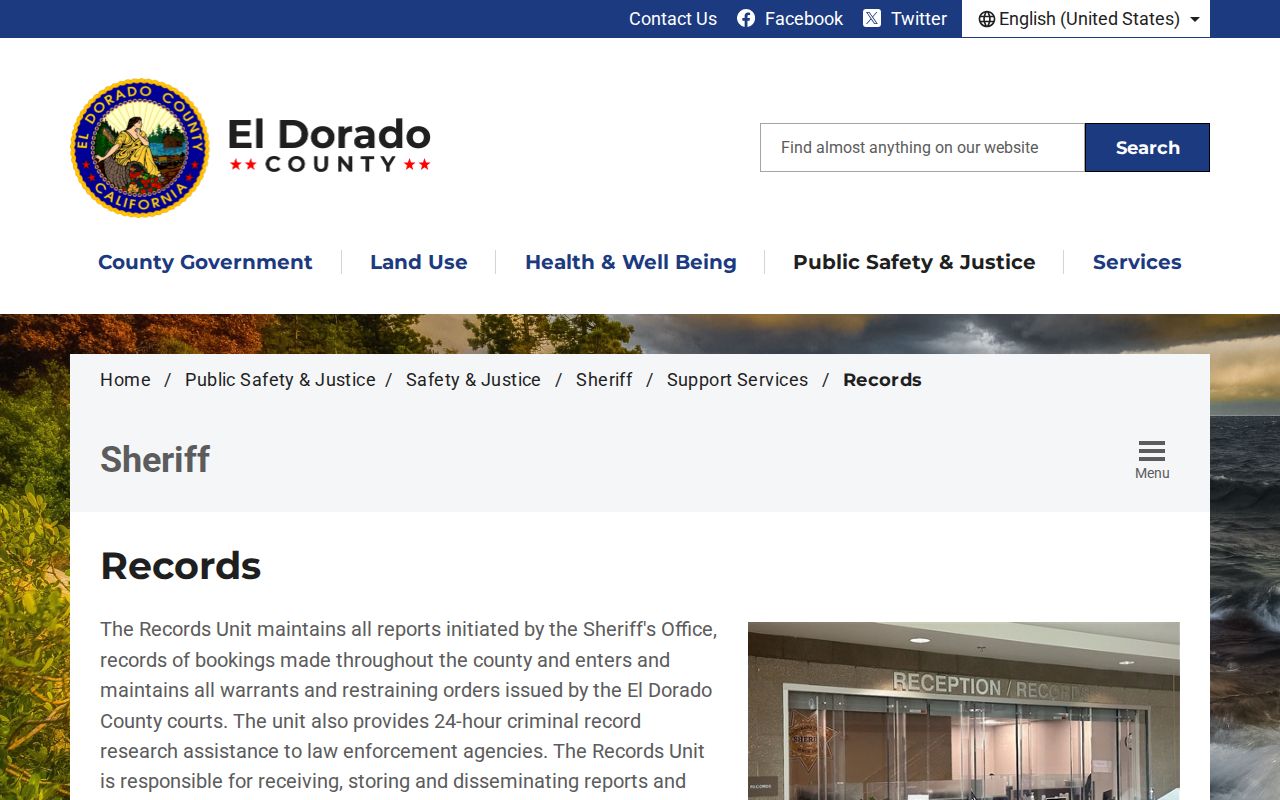
County policy is clear: handle a self-check through an office visit or the court, not a public online name search.
El Dorado Warrant Record Types
EDSO Records maintains warrants and restraining orders issued by El Dorado courts. No public county table spells out every warrant category. The distinctions below keep the record path clear without claiming anything about a specific case.
| Record type | What it means for a lookup |
|---|---|
| Arrest warrant | Judicial authority to arrest; confirm through the official self-check or court route |
| Bench warrant | A court-issued warrant tied to a proceeding; check with the court handling the case |
| Wanted profile | A public agency notice that may highlight a person; EDSO has no active county module |
| Missing-person notice | A separate safety notice that must not be relabeled as a wanted profile |
| Federal fugitive profile | A different jurisdiction and not proof of a county warrant |
An active El Dorado County warrant can exist with no wanted profile posted anywhere. Stale material creates the opposite headache. A copied or cached profile sometimes lingers online after the official version has been pulled or changed. When the two conflict, trust the agency or court over an unofficial page every time.
El Dorado Warrant Contacts
Save 911 and other emergency channels for a true immediate threat. Routine tips and questions about a warrant go to whichever agency issued or published it. No local Crime Stoppers reward program, anonymous wanted-person form, or Warrant Wednesday feature could be confirmed here, so none is promised.
200 Industrial Drive
Placerville, CA 95667
Main: (530) 621-5655
Non-emergency: (530) 621-6600
Records: (530) 621-5703
Monday-Friday, 8:00 a.m.-5:00 p.m.
The South Lake Tahoe office and Records Unit sits at 1360 Johnson Boulevard #100, South Lake Tahoe, CA 96150. The phone number is (530) 573-3000, and posted weekday hours run 8:00 a.m. to 4:00 p.m. Do not expect a warrant confirmed over the phone. For a self-check on an El Dorado arrest record or warrant, bring photo identification in person or ask the court directly.
Never approach or try to detain someone you believe is wanted. That job belongs to law enforcement. Call 911 if danger is immediate. For anything less urgent, reach the El Dorado County Sheriff's Office at (530) 621-6600.
Resolve El Dorado County Warrants
The El Dorado Superior Court record is the sound place to learn what happened after a warrant or arrest. A case often opens with an arraignment. That is the first court appearance, where charges and release conditions get sorted out. Later entries may show a plea, a dismissal, a trial result, a sentence, or another outcome. The court's recorded outcome is called the disposition.
The case index and department calendars require registration and can be searched with case or citation details. Fresh filings may not show up right away. Older matters can need a clerk search, and anything before 2000 may live in manual index books. West-slope criminal cases usually flow through the Placenville branch while South Lake Tahoe handles the east slope. The file itself is the authority on which branch holds it.
A lawyer can explain the warrant, arrange a lawful court appearance, and weigh case-specific options. No web page can promise recall, release, or dismissal. Those calls rest with the court and the facts of the case.
Files missing from the online search fall back to the court's published record-search request path. With known case details, general public criminal searches can be requested by mail or in person. Older matters and thin identifying data take more digging.
Note: Booking charges may change or never be filed, so confirm the court disposition before drawing conclusions.
Federal Wanted Lists Differ
The U.S. Marshals Service Eastern District of California may publish a limited set of federal fugitive profiles with photographs. Its 24-hour tip number is 1-888-869-4589. That resource covers federal matters and is not a complete El Dorado County warrant database. A federal profile cannot be used to fill the county's disabled most-wanted module.
Federal custody is also separate from wanted status. The Bureau of Prisons locator covers federal prisoners and released or no-longer-in-BOP-custody records from 1982 forward, but it does not display inmate photographs. ICE has a separate immigration-custody locator. Neither system proves that an El Dorado County warrant exists, and county booking information must not be used to infer federal or immigration status.
Jurisdiction and time both matter. Check the agency name, the date, and the official source before acting on any claimed match. Keep safety first, pass tips to law enforcement, and let the court record establish the outcome.